Will Instagram label my edited photo as AI? Content Credentials explained
By Pixuvia · · Updated
Instagram adds an "AI info" label to an edited photo only when it finds a sign of AI in the file or when you say you used AI. The signs Meta reads are industry metadata (Content Credentials, also called C2PA, and IPTC tags) that AI tools write into images, plus invisible watermarks. A photo you cropped, brightened or retouched by hand gives it nothing to label. A photo changed with a generative AI tool that writes those tags can get the label, though since September 2024 a photo that was only edited with AI shows it in the post's menu rather than on the post itself.
Below is how the decision works, what the labels on Instagram, Facebook and Google Photos actually say, and what the published sources leave unclear, as of November 2026.
On this page
- What triggers the AI label on Instagram?
- What does the "AI info" label say, and where does it appear?
- Does Google Photos label AI edits?
- How do invisible watermarks like SynthID work?
- What does the Content Credentials icon mean?
- What is still unclear
- Does a photo exported from Pixuvia carry AI metadata?
- Questions
- Sources
What triggers the AI label on Instagram?
It takes an AI signal in the file or your own disclosure. Meta set out its approach in February 2024: it labels images when it detects "industry standard indicators" of AI, specifically "the 'AI generated' information in the C2PA and IPTC technical standards", and it reads "both invisible watermarks and metadata embedded within image files". With them it can label images from Google, OpenAI, Microsoft, Adobe, Midjourney and Shutterstock tools. Images made with Meta's own AI carry such markers too. People can also disclose AI use themselves when they post.
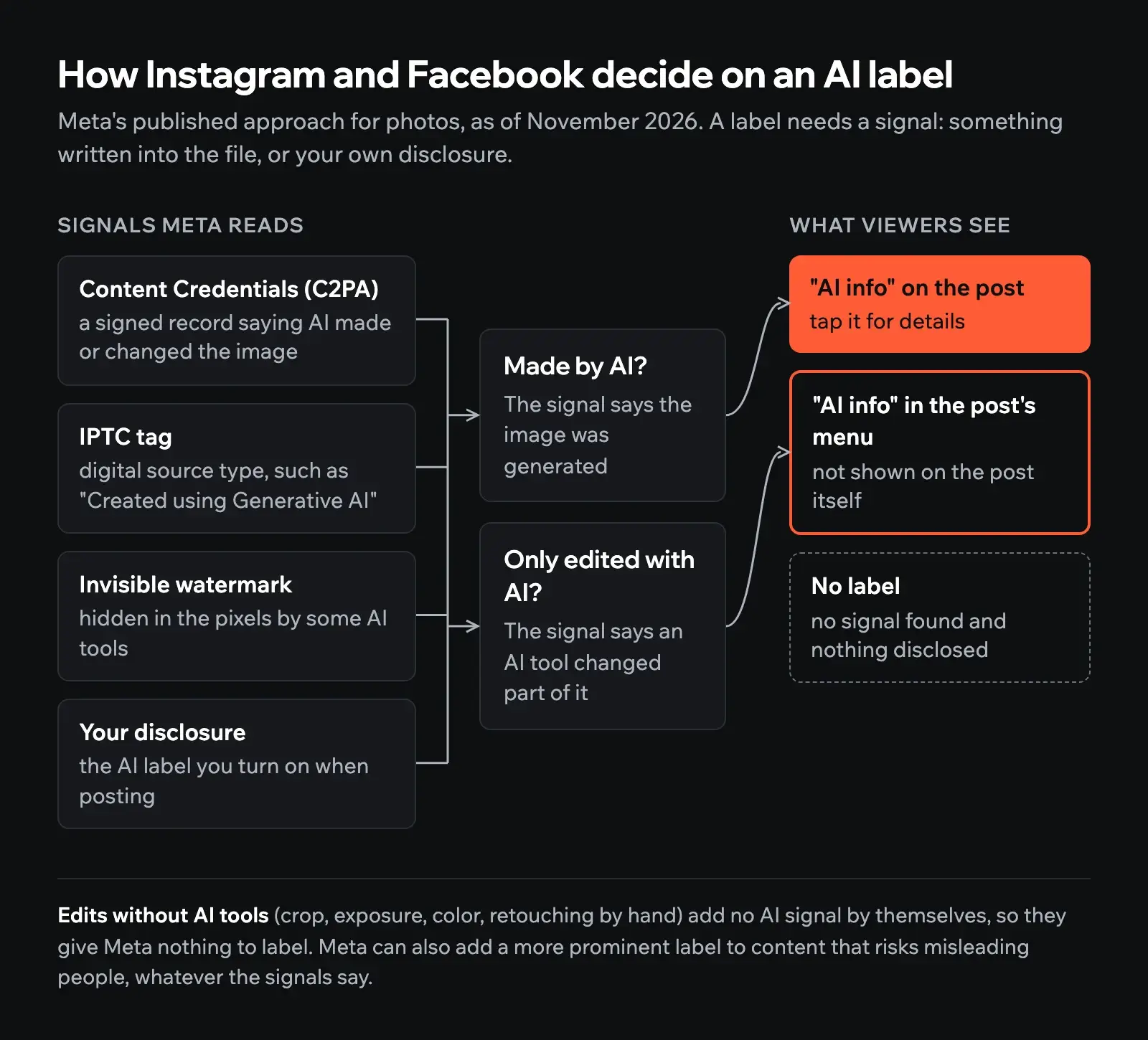
So the label follows the tool, not the look. An AI tool that writes the "AI generated" information into the file passes it on to Instagram if the file still carries it when you upload. A tool that writes nothing leaves nothing to find, unless it watermarks the pixels. Two photos edited the same way can therefore end up labeled differently, depending on the app used.
What does the "AI info" label say, and where does it appear?
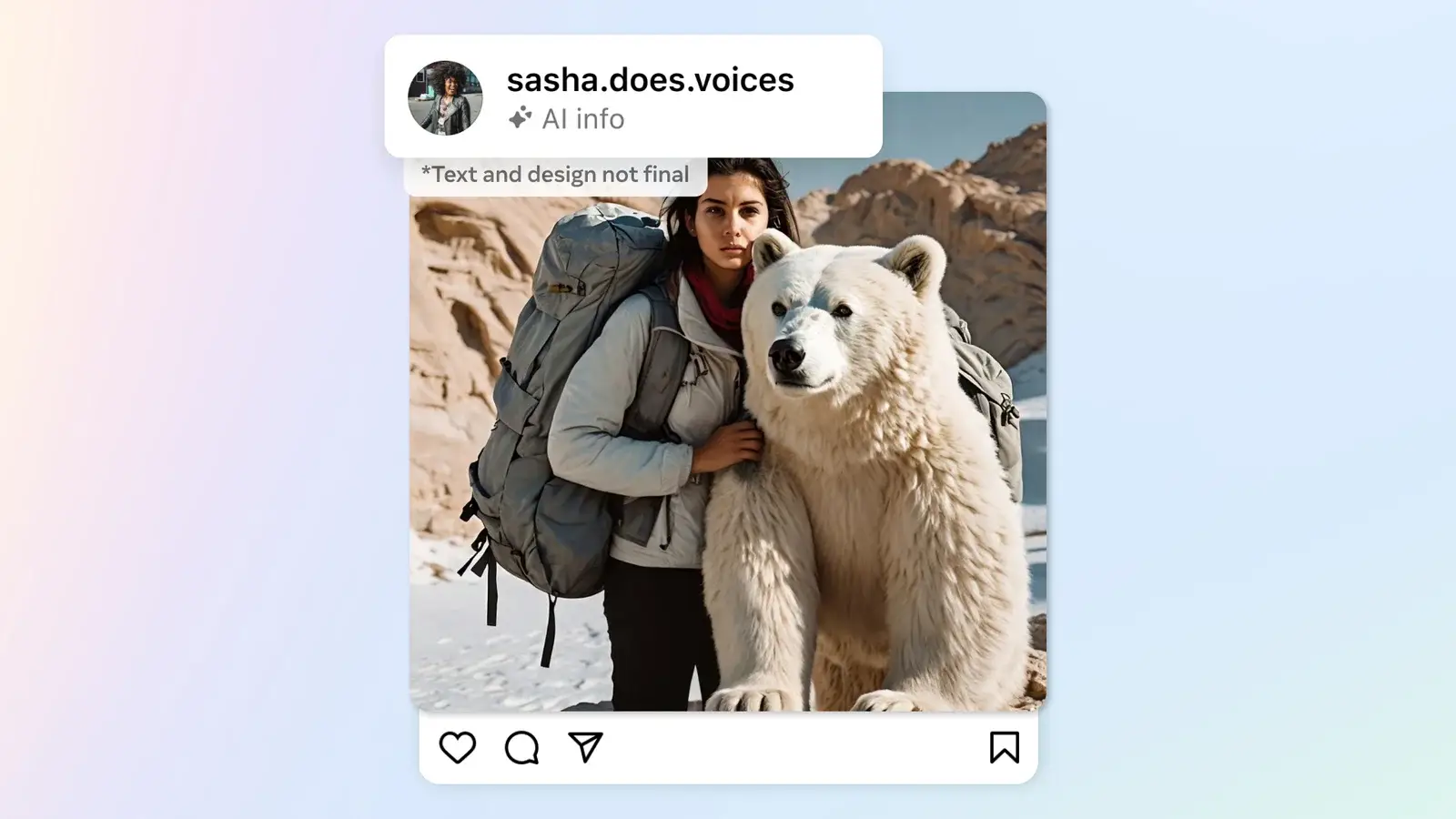
The label first read "Made with AI". Meta found that labels based on industry signals "weren't always aligned with people's expectations", as small AI retouches got the same label as generated images, and renamed it "AI info" across its apps on July 1, 2024; tapping it shows more information. On September 12, 2024, Meta split the two cases:
- Detected as AI-generated: "AI info" stays visible on the post.
- Only modified or edited by AI tools: the "AI info" label moves to the post's menu.
The details also say whether the label comes from industry signals or from the poster's own disclosure. Meta adds that it may use a more prominent label for content with a particularly high risk of misleading people.
Does Google Photos label AI edits?
Yes, and Pixel phones add Content Credentials to camera shots too. Google writes IPTC metadata into photos edited with Magic Editor, Magic Eraser and Zoom Enhance to show they were "edited using generative AI", and in October 2024 it began showing this in the Photos app next to the file name, location and backup status. IPTC's own term for this is "Edited using Generative AI"; images made entirely by AI get "Created using Generative AI". Google also tags non-generative composites such as Best Take and Add Me.
The Pixel 10 went further in September 2025: Pixel Camera attaches Content Credentials to every JPEG photo it takes, and Google Photos adds them to images edited with AI tools. A "How this was made" section in the About panel then lists entries such as "Media captured with a camera", "Edited with AI tools" and "Edited with non-AI tools".
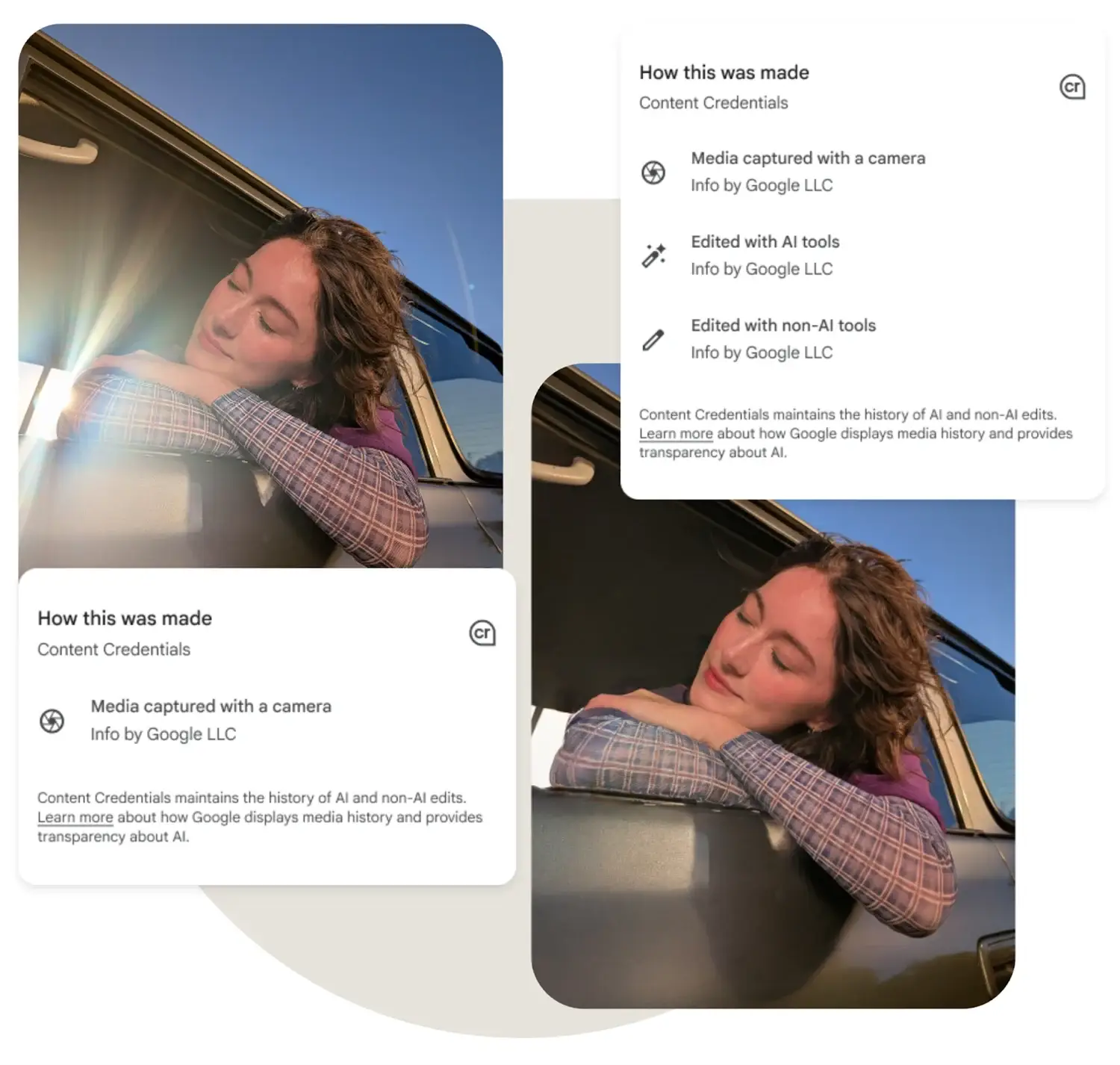
Google's point is that a label can prove a photo is real as well as flag AI. In May 2026 it said Meta will start labeling camera-captured media with Content Credentials on Instagram; we could not find a Meta page giving a date for that.
How do invisible watermarks like SynthID work?
Metadata can be lost: many apps and screenshots do not keep it. Watermarks are hidden in the pixels instead. Google DeepMind's SynthID marks content from Google's AI tools, and Google says it has watermarked over 100 billion images and videos. OpenAI says ChatGPT Images 2.6, released November 4, 2026, keeps C2PA metadata on its images and adds SynthID watermarks across ChatGPT, Codex and its API.
A watermark tells a checker that an AI tool produced or changed the pixels. It is not a label by itself: a platform has to look for it. Meta says it reads invisible watermarks, but it does not publish which ones.
What does the Content Credentials icon mean?
Content Credentials can carry a small "cr" pin icon. It means only that the file holds a credentials record; the record may say "captured with a camera" as easily as "made with AI". The C2PA's own guidance for apps warns about the "implied truth effect": when some images carry a disclosure, people may assume unlabeled ones are more likely authentic.
Several articles say visitors at CES 2026 read the icon as an AI warning. We found no primary source for that, such as a study or a talk recording, so treat it as unconfirmed. The safe reading is the C2PA's: the icon is a door to the record, not a verdict.
What is still unclear
- Which invisible watermarks Meta detects, and whether it reads SynthID.
- Exactly which AI edits count as "only modified" rather than "generated" in Meta's checks.
- When Instagram's labels for camera-captured photos arrive.
- How each app treats credentials when it re-saves a photo: some keep them, many drop them.
Does a photo exported from Pixuvia carry AI metadata?
No. Pixuvia does not add Content Credentials, IPTC AI tags or watermarks of its own. The Editor encodes the PNG, JPEG and WebP files it exports fresh from the image on the canvas, so metadata from the opened file, including any credentials, is not carried over; the converters likewise do not copy photo details such as the date and location.
The AI tools in the Studio and the Editor run on models from several makers, and some of those makers watermark what their models produce. We have not tested whether those watermarks survive in our results. If a platform asks you to disclose AI use, its own AI label is the way to do it. For how editing by prompt works, see how to edit a photo with AI; to fit a photo to a post, see how to resize an image for social media.
Questions
Will Instagram label my photo if I only adjusted brightness or cropped it?
Not because of those edits. Meta labels images from AI signals in the file (C2PA or IPTC information saying AI was used, or an invisible watermark it can read) or from your own disclosure. Ordinary adjustments add no such signal by themselves.
What does "AI info" on Instagram mean?
That Meta found signs of AI use or the poster disclosed it. Tapping the label shows more, including whether it came from industry signals or self-disclosure. Since September 2024, photos only edited with AI tools get the label in the post's menu rather than on the post.
Does Google Photos mark photos edited with Magic Editor?
Yes. Google says photos edited with Magic Editor, Magic Eraser and Zoom Enhance carry IPTC metadata showing they were edited with generative AI, and the Photos app shows this with the file name, location and backup status.
Can a platform detect AI without metadata?
Sometimes. Invisible watermarks such as Google DeepMind's SynthID sit in the pixels, not the metadata, and Meta says it reads invisible watermarks as well as metadata from other companies' tools. Which watermarks Instagram can read today is not listed publicly.
Does the Content Credentials icon mean a photo is AI?
No. The "cr" icon means the file carries a Content Credentials record, which can describe a camera capture, ordinary edits or AI use. Open it to read what the record says.
Sources
- Meta: Labeling AI-generated images on Facebook, Instagram and Threads (February 6, 2024)
- Meta: Our approach to labeling AI-generated content and manipulated media (April 5, 2024, updated July 1 and September 12, 2024)
- Google: More transparency for AI edits in Google Photos (October 24, 2024)
- Google: How Pixel and Android are bringing a new level of trust to your images with C2PA Content Credentials (September 10, 2025)
- Google: Making it easier to understand how content was created and edited (May 19, 2026)
- IPTC: Digital Source Type vocabulary
- C2PA: Specifications
- C2PA: User experience guidance for implementers
- Google DeepMind: SynthID
- OpenAI: ChatGPT Images 2.6 system card, Image provenance